Stop wasting time building features that don’t deliver.
Hypothesis-driven development is the proven framework that replaces guesswork with data — helping product teams move faster, reduce risk, and build digital products users actually want.
What is Hypothesis-Driven Development?
Hypothesis-driven development (HDD) is a product development methodology in which teams form structured, testable assumptions before committing to building anything. Rather than debating opinions in planning sessions or shipping features based on gut feeling, each idea is treated like a scientific experiment: you state your hypothesis, design a test, gather evidence, and make data-backed decisions about what to build next.
At Sonin, hypothesis-driven development sits at the heart of how we approach every digital product engagement. It’s how we help our clients move with speed and confidence — reducing the risk of costly misdirection and shortening the path to product-market fit.
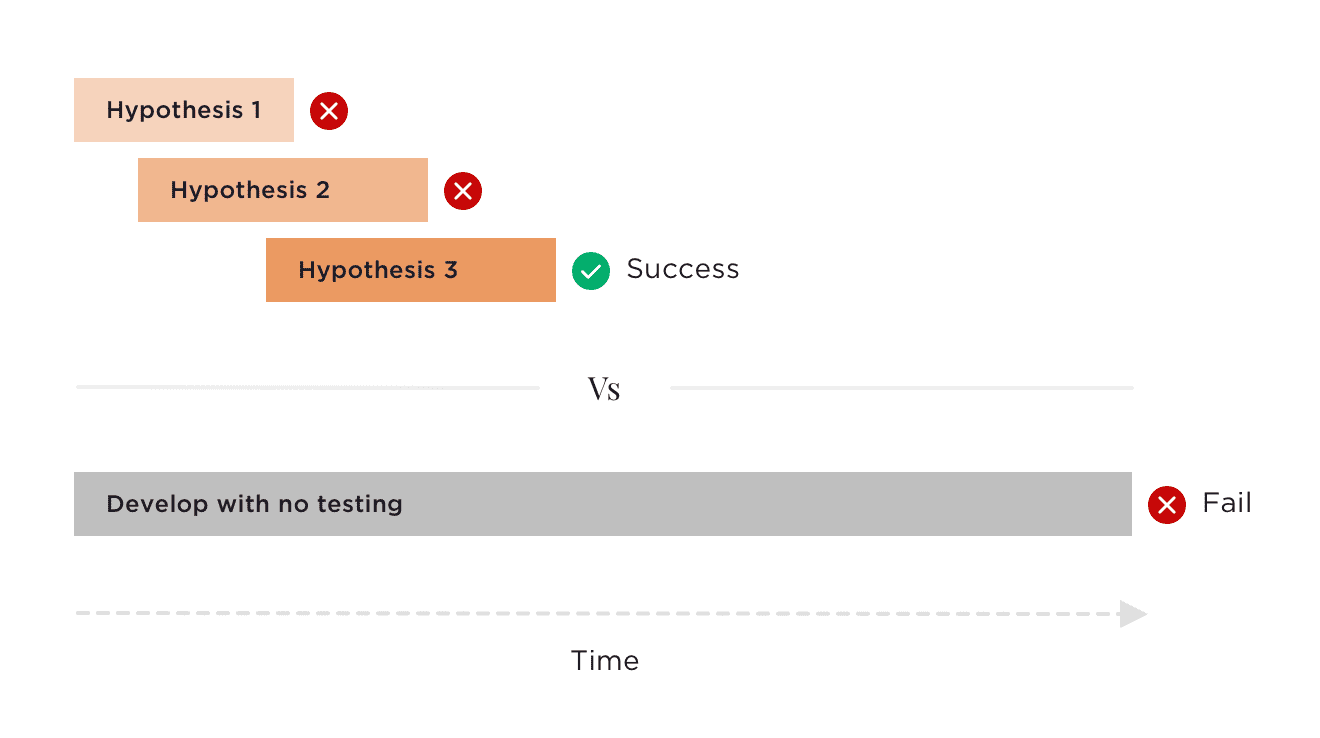
Why Traditional Product Planning Falls Short
If you’ve ever sat through an endless roadmap meeting, you already know the problem.
Everyone has an opinion. Priorities shift based on whoever speaks loudest or most recently. And by the time you’ve reached a decision, weeks have passed — often resulting in a feature that still hasn’t been validated with actual users.
When you do ship, the data often arrives too late and gets interpreted too subjectively. Teams add caveats to failures. They oversell successes. The feedback loop is broken.
Hypothesis-driven development fixes this by replacing opinion with evidence. There is no room for subjective interpretation — only objective signals that tell you whether your solution is working or not.
To discuss your businesses’ approach to Hypothesis Driven Development, speak to our experts today.
The Business Case for Hypothesis-Driven Development
- Faster time-to-learning: You gather meaningful insight in days, not months
- Lower cost per successful feature: By testing before building, you stop investing in features that don’t work
- Reduced product risk: Failed hypotheses aren’t failures — they’re cheap, valuable learning
- Stronger product-market fit: You build a clearer picture of what your users actually need with every iteration
- Team alignment: Decisions are anchored to shared goals, not departmental politics
“The benefit of hypothesis-driven development over basing decisions on hunches, guesses, and beliefs is that it’s scientific in its approach. There’s no space for subjectivity — only objective learning and discovery. It’s a faster route to finding your product-market fit.”
How Hypothesis-Driven Development Works: Our Process at Sonin
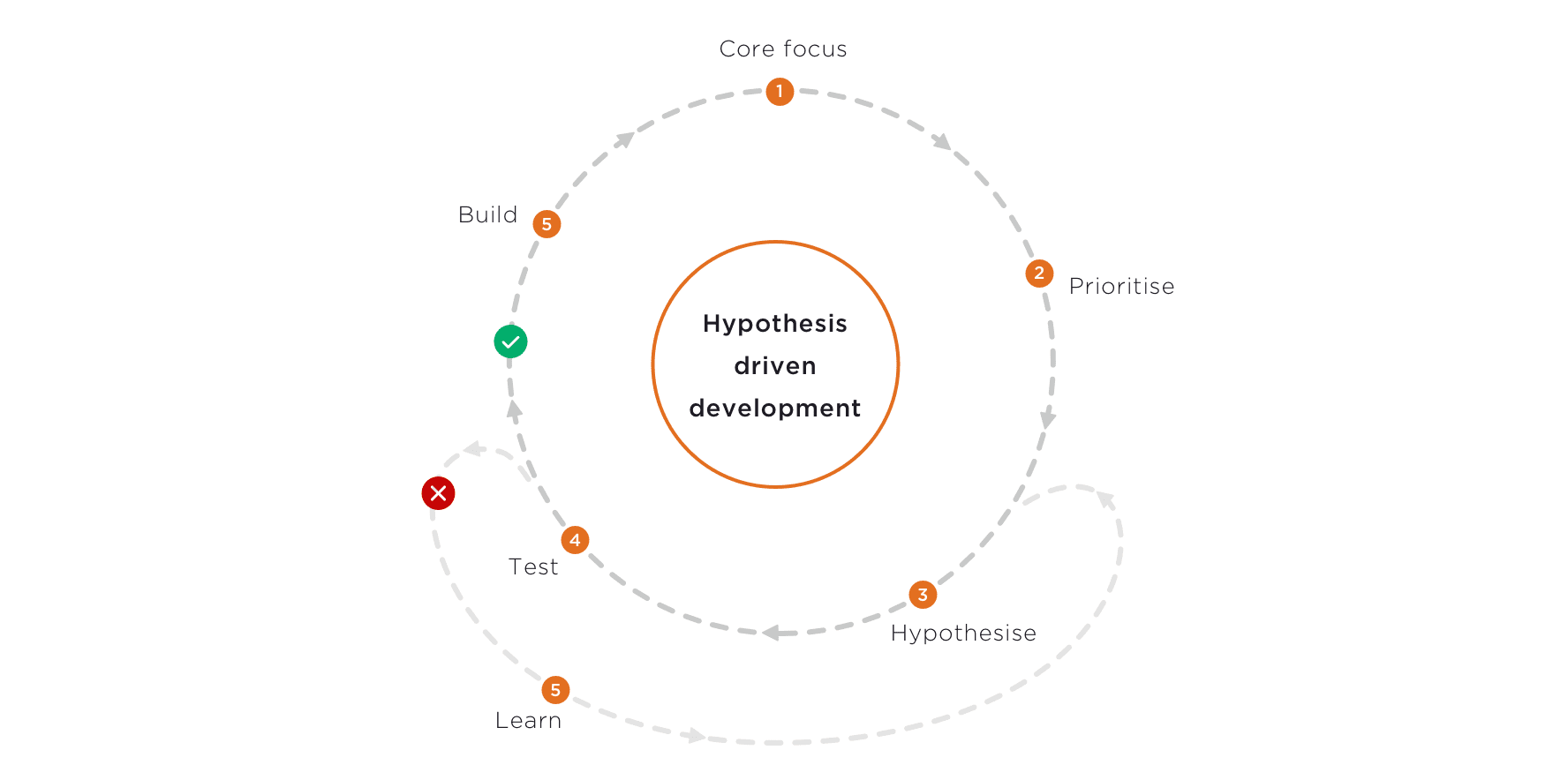
1. Define Your Core Focus
Every effective product strategy begins with a single, unifying metric — your core focus. This is the overarching goal that best represents the value your business is trying to create. It sits above departmental KPIs and scorecards, giving every team a shared direction to align behind.
When your core focus is clearly defined, decisions become dramatically easier. Every feature, every sprint, every hypothesis can be evaluated against the same question: does this move us closer to our goal?
2. Prioritise the Right Problems
We start each engagement by surfacing all the problems and desired outcomes on the table — the full, often overwhelming picture. Then we get to work filtering it.
Using a combination of stakeholder workshops and continuous “why” questioning, we trace surface-level issues back to their root causes. This prevents teams from solving the wrong problem or building features that address symptoms rather than causes.
From there, prioritisation is straightforward: every item is evaluated against its potential impact on your core focus. The loudest voice in the room no longer wins. The most strategically important problem does.
3. Write a Scientific Hypothesis
Once we’ve identified the highest-priority problem, we write a structured hypothesis using a proven formula that connects business outcomes to user needs:
“We believe we can achieve [prioritised business outcome] if, when [action], a user is able to [goal] so they can achieve [desired outcome] by [proposed solution]. We will have the confidence to proceed when we observe [measurable signals].”
This isn’t just a user story. It’s a business case and a success condition wrapped into one. The measurable signals at the end are critical — they’re what distinguish a validated learning from a judgement call.
4. Test Rapidly with Design Sprints
With a hypothesis in hand, our team runs focused design sprints to create lightweight prototype solutions — fast, with minimal resource commitment. These prototypes are tested directly with real users through one-on-one sessions, group testing, or in-context field research.
We capture both qualitative insight (what users say and how they behave) and quantitative data (whether the solution moved the needle on the metric we’re tracking). The result is a clear, evidence-backed answer: does this work or doesn’t it?
5. Build or Burn — Then Repeat
If the hypothesis is validated, you move into production with confidence. You know the investment is justified because the evidence says so.
If the hypothesis fails, you’ve lost a few days — not months. You walk away with a definitive learning that directly informs your next move. Either outcome has value. Either outcome makes your product smarter.
The more cycles you run, the faster and cheaper each one becomes.
The Key Metric: Cost to Deliver a Successful Feature
Across every hypothesis-driven development cycle, one number matters above all others: the cost to deliver a successful feature.
This metric captures the average time, effort, and resource required to ship a feature that genuinely adds value for users and moves the needle for your business. By testing assumptions before committing to a build, you dramatically reduce this cost over time.
The teams that master this metric build better products, faster — and at a fraction of the cost of competitors who are still guessing.
Start with Alignment: Our Discovery Workshops
The foundation of any hypothesis-driven approach is alignment — across business goals, user outcomes, and the obstacles standing in the way.
Our Discovery Workshops are designed to create exactly that. We work closely with your team to define your core focus, surface your highest-impact priorities, and generate solution ideas that are ready to test. By the end of a workshop, your team leaves with a shared direction and a validated roadmap — not a slide deck of assumptions.
Ready to Build the Right Product?
If your product development process is driven by opinion rather than evidence, you’re not just moving slowly — you’re moving in the wrong direction.
Hypothesis-driven development is how the best digital product teams work. It’s how we work at Sonin — and it’s how we help our clients outpace the competition.
Talk to our team today and find out how hypothesis-driven development can transform your product strategy.