Apple is reportedly testing more visually blended ads in App Store search results on iOS 26.3, raising questions about transparency, trust, and the shift toward pay-to-play discovery.
The main shift is that substance and relevance now outweigh spend. Early tests found that apps optimising their creative assets saw 25% higher user engagement than those boosting only ad spend, showing that relevance significantly impacts results.
Apple isn’t radically changing the App Store; rather, it’s formalising discovery as high-intent, competitive, and compressed. Counterintuitively, this may reduce the impact of brute-force spending.
This isn’t a land grab. It’s a normalisation.
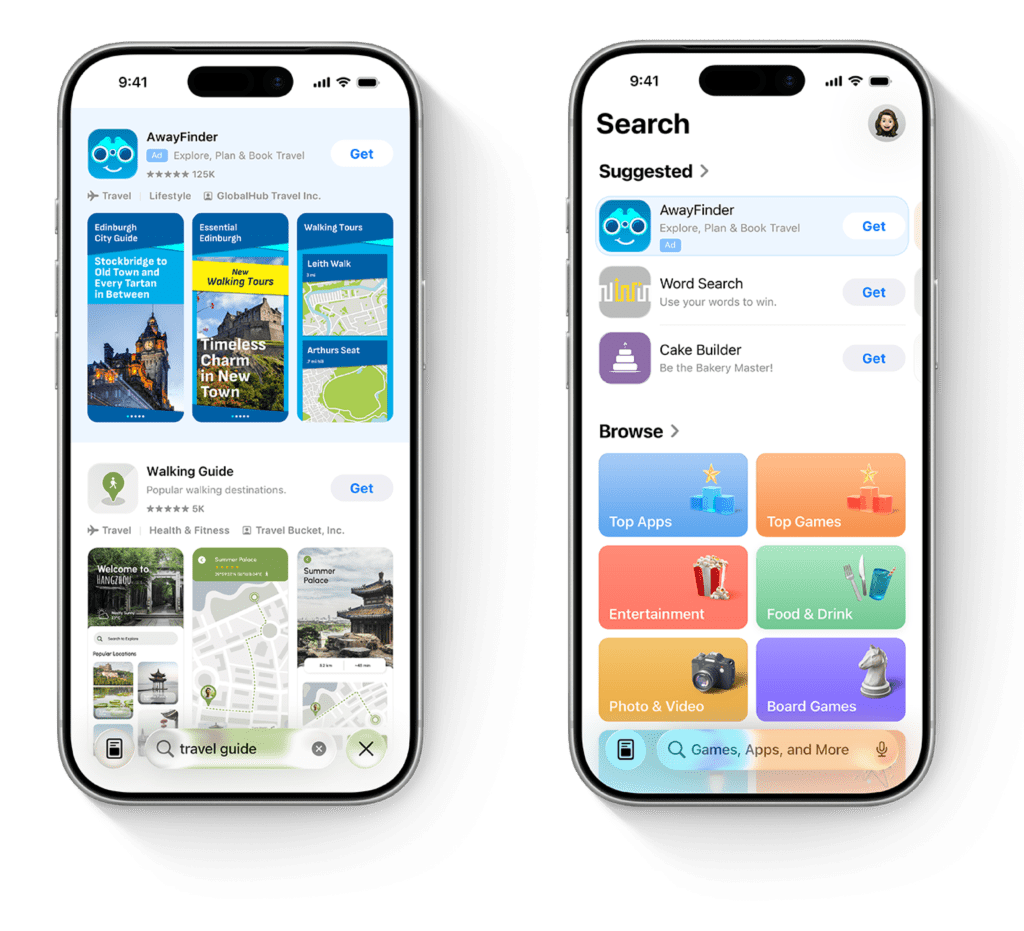
Apple has steadily expanded App Store ad inventory. The key change now is how visible the distinction between paid and organic must be in a relevance-driven search experience.
Early tests show ads that blend into search results depend less on visual separation and more on user intent. The focus moves from “this is an ad” to “this is a relevant result”, with sponsored labels still present.
That mirrors the evolution of every mature search product. The App Store is simply catching up to its own behaviour.
This matters because search already dominates App Store discovery. According to Apple, nearly 65 percent of app downloads occur directly after a search. In this environment, discovery is less about browsing and more about users searching for specific apps or categories. It’s about selection under time pressure.
Why this move makes sense for Apple
For Apple, the App Store has to balance two things that often conflict: monetisation and trust. Advertising is now a meaningful contributor to Apple’s Services revenue, which exceeded $85 billion annually, and App Store search is one of the most valuable surfaces in that portfolio because intent is explicit.
Users searching the App Store are not passively consuming content. They are actively deciding. Apple has strong incentives to monetise that moment, but even stronger incentives not to undermine it.
Blended ads balance monetisation and relevance. In-app advertising has more than doubled since 2019 as developers blend ads to monetise and reach wider audiences, keeping engagement and revenue in view.
Seen this way, this isn’t a philosophical shift. It’s a design optimisation aligned to user behaviour.
The misunderstood part: this actually weakens brute spend
The assumption that blended ads make the App Store “pay to play” holds only if paid placement is awarded solely on the basis of budget. That isn’t how Apple Search Ads work, and hasn’t for some time.
Apple has been explicit, in Search Ads documentation and WWDC sessions, that ad ranking is determined by a combination of bid, relevance, and expected conversion. In practice, this means higher-quality, better-converting apps often pay less per install than poorly optimised apps that are willing to spend more.
This is a relevance-weighted auction, not a billboard.
Industry benchmarks reinforce this. Multiple ASO platforms report that improvements to creative assets alone, such as integrating social proof in screenshot two, previews, and messaging can drive a 20 to 30 percent or more increase in conversion rates, often without any change in ranking position. Because Apple’s auction model factors expected engagement into pricing, those conversion gains directly improve cost efficiency.
Blended ads make relevance essential. When ads resemble organic results, the accuracy of your app’s metadata becomes critical to budget efficiency and visibility across channels. Clarity and relevance in listings make exposure cost-effective.
The real shift is scrutiny, not visibility.
As paid and organic results converge visually, the user’s decision-making changes. Less scanning. Fewer comparisons. Faster judgment.
In that environment, the differentiator isn’t whether an app appears. It’s whether it earns selection in seconds.
This increases the importance of positioning and credibility. When paid placement isn’t obvious, users quickly judge if a listing communicates a clear outcome. Immediate clarity becomes the key differentiator.
This is why blended ads don’t diminish ASO; they intensify it.
ASO evolves from ranking to decision optimisation, now positioned between marketing, UX, and product strategy. That complexity makes it challenging for many teams.
Paid and organic were never separate systems.
Blended ads expose a fiction that has existed for years: that paid acquisition and ASO operate independently.
Search ads reveal real intent. They show which problems users are actively trying to solve, which language resonates at the moment of decision, and which promises actually convert. When those insights don’t inform metadata, creative, onboarding, and even roadmap priorities, inefficiency creeps in fast.
In a blended environment, that inefficiency becomes visible. According to Watsspace, any disconnect between paid advertising messages and organic app store content quickly becomes evident in conversion rates and rising acquisition costs, making it challenging for some teams to feel comfortable with blended ad strategies. Not because they can’t spend, but because they can’t justify it.
Transparency hasn’t disappeared. Responsibility has shifted.
Concerns about transparency are understandable, especially given Apple’s brand positioning. But transparency in discovery is not just about labels. It’s about alignment between promise and experience.
If an app appears in a result, sponsored or not, and delivers what the listing implies, trust is reinforced. If it doesn’t, disappointment follows regardless of placement type.
According to Apple’s advertising policies, blended ads must be supported by adequate evidence for any claims, which means there is less tolerance for vague positioning or exaggerated statements. This ensures that, while consumers still have choices, clearer, faster judgments are made, effectively raising the standards for ad content.
What this signals for serious product teams
The key takeaway is that discovery is not becoming unfair; instead, average products will pay more as mediocrity becomes increasingly expensive.
The App Store is optimising for outcomes, not exploration. Users are deciding faster. Apple is rewarding relevance more aggressively. Products that are sharply positioned and genuinely useful will continue to perform, often more efficiently than those that rely solely on budget.
This is less about tactics and more about coherence. About whether a product knows who it’s for, what problem it solves, and how to communicate that under pressure.
Where Sonin comes in
At Sonin, this is exactly the intersection we work in: product clarity, growth strategy, and marketing effectiveness.
We help teams get more out of ASO, paid acquisition, and App Store visibility by aligning them with the product’s reality rather than fighting the platform. That means reducing wasted spend, improving conversion, and ensuring visibility is backed by substance.
Blended ads don’t require a new trick. They expose whether the fundamentals are sound.